SEO Software for Webmasters: Beyond Basic Tools (2026)
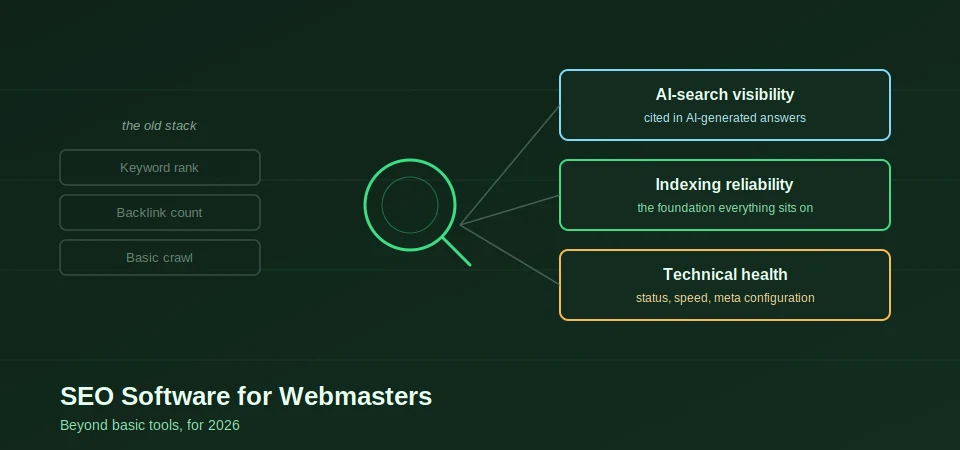
The webmaster's toolkit has quietly changed more in the last two years than in the previous ten. For a long time, "SEO software" meant a keyword tool, a rank tracker, and maybe a backlink checker. That stack still matters — but on its own, it now leaves you blind to the parts of search that are growing fastest. If your tools only measure how you rank in a list of blue links, they're measuring a shrinking share of how people actually find information. This is what moving beyond basic tools really means in 2026.
What "Basic Tools" Miss in 2026
Traditional SEO software was built for a world where the search results page was ten blue links — but that page increasingly opens with an AI-generated answer, and basic tools can't see whether you're in it.
When someone asks a question today, Google often answers directly at the top with an AI Overview, synthesizing information from multiple sources before the user ever scrolls to a traditional result. A keyword tool will happily tell you that you rank third for a term — while saying nothing about the fact that an AI answer sits above all ten results and may not mention you at all. That's not a small blind spot. For informational queries, it can be the difference between visibility and invisibility.
The Rise of Zero-Click and AI-Answered Search
A growing share of searches are now resolved without a click, because the answer appears directly on the results page. This doesn't make SEO pointless — it changes what winning looks like. Instead of only chasing the top organic position, webmasters increasingly need to know whether their content is being used and cited in the answers that satisfy searches directly. Basic tools were never designed to measure that.
The Modern Webmaster's Expanded Toolkit
Beyond the traditional keyword-and-rank stack, the modern toolkit adds three layers: technical health, AI-search visibility, and indexing reliability. Each addresses a gap that basic tools leave open.
Technical Health as a Foundation
Rankings and AI visibility both sit on top of technical fundamentals, and problems there quietly undermine everything above them. A page returning the wrong HTTP status, a slow server response, or a broken meta configuration can drag down performance no matter how good the content is. Regularly checking these with tools like a website status checker and a meta tags checker catches issues that never show up in a rank tracker but silently cost you visibility.
AI-Search Visibility
This is the layer basic tools miss most completely. Knowing whether your content appears in AI-generated answers — and whether it's cited as a source — is becoming as important as knowing your keyword rankings. An AI search visibility checker addresses a question a traditional rank tracker simply can't answer: not just where you rank, but whether you exist inside the AI answer that increasingly comes first.
Indexing Reliability
None of the above matters if your pages aren't indexed to begin with. Indexing is the foundation every other SEO effort is built on — a page that isn't in the index can't rank and can't be cited, no matter how well optimized it is. Confirming index status is therefore not an advanced task but a baseline one, and it's one of the most overlooked checks in the entire toolkit.
Backlinks Still Matter, But the Question Changed
Backlink checking hasn't disappeared from a modern toolkit — it's just asking a different question than it used to. The old approach was largely a numbers game: more links, higher domain authority, better rankings. That correlation still exists, but it's weaker and noisier than it was, because search engines got considerably better at discounting links that exist purely to manipulate rankings rather than reflect genuine editorial trust.
The more useful modern question isn't "how many links do I have" but "would a real editor at a relevant, respected site actually choose to reference this page." A backlink profile heavy on directory listings and low-quality guest posts can look impressive in raw count while contributing almost nothing to actual trust signals. Checking an IP reputation checker against your own linking domains occasionally reveals an uncomfortable surprise: a chunk of "backlinks" sitting on infrastructure shared with spam networks, quietly working against the site rather than for it.
How to Actually Choose Between the Available Tools
Faced with dozens of tools claiming to cover these bases, most webmasters default to picking whatever ranks first in their own search results — which is a reasonable enough starting point, but not a particularly rigorous one. A better filter: does the tool tell you what to do next, or does it just hand you a number and leave the interpretation to you?
A rank tracker that says "you're in position 14" gives you a fact. A rank tracker that says "you're in position 14, and the top three results all have a dedicated FAQ section yours is missing" gives you a decision. The second kind is worth paying for, or at minimum worth prioritizing among free options, because the gap between measuring and diagnosing is exactly where most webmasters' time gets wasted staring at dashboards without a clear next action.
A Practical Test Before Committing to Any Tool
Before settling into a workflow built around a specific tool, run one real test: take a page you already know is underperforming, and see whether the tool actually surfaces a plausible reason why, not just confirms the underperformance you already knew about. A tool that only restates the problem back to you in slightly different words isn't adding much beyond what a manual glance at your analytics would have told you already.
It's worth applying this same test across your whole stack periodically, not just when adopting something new. Tools that were genuinely useful a year or two ago sometimes quietly stop earning their place as a site's needs evolve — a technical checker that was essential during a messy migration might become redundant once the site has been stable for months, freeing up budget or attention better spent on the AI-visibility and indexing checks that matter more as search itself keeps shifting.
Why an Integrated Approach Beats Scattered Tools
The advantage of a modern toolkit isn't just having more tools — it's using them as a connected workflow where each check informs the next.
Scattered, single-purpose tools create scattered, single-purpose insights. You check rankings in one place, technical health in another, and never connect the two — so a ranking drop caused by a technical issue looks like a mystery. An integrated approach treats these as one system: when rankings slip, you check indexing and technical health in the same workflow, and the cause usually reveals itself quickly. This is what separates reactive SEO, where you scramble after traffic drops, from proactive SEO, where you catch problems before they cost you.
From Measuring to Diagnosing
Basic tools tell you what is happening — your ranking went down, your traffic dropped. The more valuable question is why, and answering it requires tools that diagnose rather than just measure. Was the page deindexed? Did a technical error creep in? Is an AI answer now capturing the query? A toolkit built to answer those questions turns raw metrics into actual decisions.
Building Your Toolkit Without a Big Budget
Moving beyond basic tools doesn't require an expensive enterprise subscription — many of the most important modern checks are available for free.
The premium suites are powerful, but much of their cost pays for features many webmasters never use: bulk historical databases, large-team reporting, and agency-scale crawling. For an individual site owner or a small team, the essential modern checks — technical health, indexing status, AI visibility, on-page structure — are available through free, focused tools. The goal isn't to own the most expensive software; it's to cover the layers that matter, which is entirely achievable on a modest or nonexistent budget.
Start With Fundamentals, Then Expand
A sensible order is to secure the foundation first: confirm your key pages are indexed and technically sound, then layer on AI-visibility checks and content optimization once the basics are solid. There's no value in optimizing content for AI answers on a page that isn't even in the index yet. Getting indexed is the floor everything else builds on.
What This Looks Like on an Actual Site
Consider a small business site with maybe forty pages, run by someone who's genuinely good at their trade but not a full-time SEO specialist. Six months ago, "SEO" meant checking a rank tracker once a week and calling it done. Under that old model, three technical redirects broke silently after a site migration, two important pages slipped out of the index without anyone noticing, and a competitor's page had quietly started appearing inside an AI-generated answer for the exact question this site used to rank well for.
None of that showed up in the rank tracker directly — rankings for the tracked keywords looked roughly stable, because the tool was only measuring the one thing it was built to measure. It took a broader pass — a technical health check, an indexing status check, and finally an AI visibility check — to surface all three issues in a single afternoon, rather than discovering them one at a time over the following months as traffic quietly eroded.
The lesson isn't that the old stack was worthless — it correctly reported what it was designed to report. It's that a toolkit built entirely around one layer of measurement will always have blind spots exactly where the newer layers of search now live.
Frequently Asked Questions
Are traditional SEO tools still worth using?
Yes — keyword research and rank tracking remain useful. The point isn't to abandon them but to recognize what they don't measure, and to add tools for technical health, indexing, and AI-search visibility alongside them.
What is AI-search visibility and why does it matter?
It's whether your content appears in and is cited by AI-generated answers, like Google's AI Overviews. It matters because those answers increasingly sit above traditional results, capturing attention — and sometimes the entire query — before a user reaches the classic list of links.
Do I need to pay for good SEO software?
Not necessarily. Premium suites add value mainly through scale and historical data. The core modern checks — technical health, indexing, on-page structure, AI visibility — are available through free, focused tools that cover what most individual webmasters actually need.
The one place price does start to matter more is scale — running these checks across five pages a week costs nothing but time, but a three-hundred-page site needs something automated behind it, or the manual approach quietly stops happening the moment things get busy.
What's the single most overlooked check?
Indexing status. Webmasters often optimize content and chase rankings without confirming the page is even in the index — and an unindexed page can't rank or be cited no matter how good it is.
How Do I Know if My Tools Are Missing Something?
If your tools only tell you where you rank in traditional results, they're missing AI-search visibility and often technical and indexing signals too. If you can't answer "am I in the AI answer?" and "is this page indexed?", there's a gap worth filling.
How often should a webmaster actually run these checks?
Technical health and indexing status are worth a quick pass weekly for an active site — problems in these areas tend to compound the longer they go unnoticed. AI-search visibility and backlink quality move more slowly and hold up fine on a monthly review, since meaningful shifts there rarely happen week to week.
Can a small, single-person site realistically keep up with all of this?
Yes, and often more easily than a larger team — a solo webmaster isn't coordinating a full toolkit across multiple people, just running through a personal checklist. The real time cost isn't the checking itself, which takes minutes with the right tools, but building the habit of doing it consistently rather than only when something visibly breaks.
Is it worth switching tools if my current stack "still works"?
Not automatically. If your current tools are genuinely answering the questions that matter — technical health, indexing, AI visibility, not just traditional rankings — switching for its own sake adds migration cost without a clear benefit. The honest test is whether your current stack can actually answer those specific questions, not whether it feels dated.
Moving beyond basic tools isn't about chasing the newest software — it's about measuring the parts of search that basic tools were never built to see. Technical health, indexing reliability, and AI-search visibility are the layers that increasingly decide whether your work gets found. And since indexing is the foundation all of it rests on, that's the right place to start: for a complete, step-by-step walkthrough of getting your pages indexed across Google, Bing, and Yandex, see our full guide on how to get your website indexed.


&media=https://seosoftwareai.com/assets/images/frontend/blog/6a5c05f5cc7ba1784415733.webp)