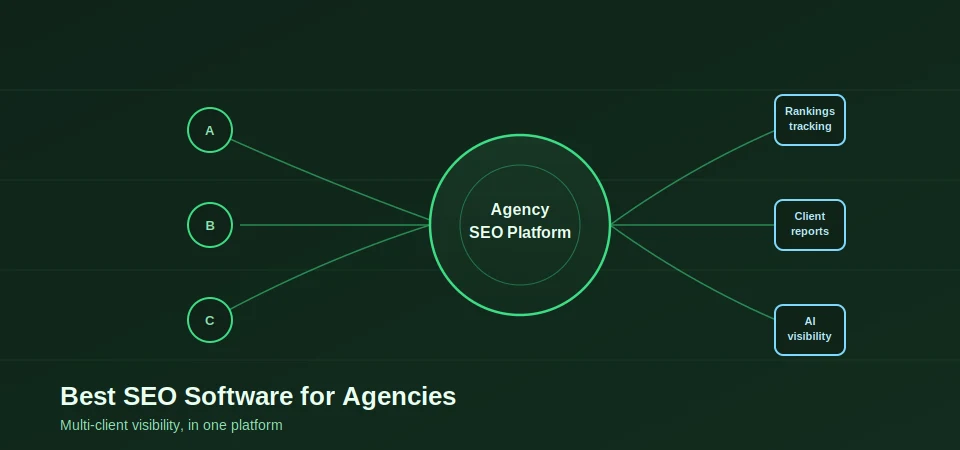
Best SEO Software for Agencies
Most agencies don't lose clients over strategy — they lose them over speed. A junior account manager spending three hours a week pulling manual ranking reports is three hours not spent on the work that actually keeps a client happy. That's the real argument for the best SEO software for agencies: it's not about chasing a shinier dashboard, it's about removing the manual work that quietly eats every account manager's week.
In 2026, that manual work looks different than it did even two years ago. Rankings in a list of blue links are only part of the picture now. A growing share of searches get answered directly inside Google's AI Overviews, or inside tools like Gemini and ChatGPT, before a user ever clicks a result. Agencies that are still reporting on rankings alone are already missing half the story their clients actually care about.
What Is AI SEO Software for Agencies?
AI SEO software for agencies is a platform that uses machine learning to automate the technical audits, content planning, and performance tracking that used to require a full team working across a dozen disconnected tools. Instead of switching between a crawler, a keyword tool, a rank tracker, and a spreadsheet to build one client report, the whole workflow lives in a single system built for handling many clients at once.
The practical difference shows up fast. Run a full-site audit with a modern webmaster and site-health toolkit, and instead of a flat list of broken links, you get a prioritized view of what's actually hurting a client's visibility this week — sorted by impact, not just alphabetically by error type. That's the shift agencies are paying for: less raw data, more decisions already half-made for you.
How AI Agents Handle Day-to-Day Optimization
An AI SEO agent, in practical terms, is a script that runs one job continuously without anyone remembering to trigger it — watching for new 404 errors overnight, flagging a sudden drop in a tracked keyword, or noticing a competitor picked up ten new backlinks in a week. None of that replaces strategic thinking. What it replaces is the person who used to check for all of it manually every Monday morning.
For a boutique shop with three clients, that might mean one person finally has time to actually read the audit instead of just producing it. For a larger firm managing dozens of accounts, it's the difference between catching a technical issue the day it happens versus the day the client complains about it.
What to Look for in the Best SEO Agency Software
The strongest platforms for agencies share three things: multi-seat team access so more than one person can work a client account without stepping on each other, white-label reporting so the output looks like your agency's work and not a third-party tool's, and API access so the platform connects to whatever else your stack already runs on.
What separates the top tier from everything else in 2026, though, is whether the software tracks Generative Engine Optimization (GEO) — whether it can tell you if a client is actually being mentioned inside AI-generated answers, not just where they rank in a traditional results page. Most established agencies have already moved away from juggling five or six narrow point tools in favor of one consolidated platform, and GEO visibility is quickly becoming one of the reasons a new platform switch gets justified internally.
Feature Comparison: Legacy Tools vs. Modern AI Platforms
| Feature Area | Legacy Software | Modern AI SEO Software |
|---|---|---|
| Search Visibility | Traditional ranking position only | Rankings + AI Overview and generative-answer tracking |
| Client Reporting | Manual PDF exports | Automated, white-labeled dashboards |
| Technical Auditing | Manual review of crawl reports | Prioritized, automated issue detection |
Extra Considerations for B2B and Enterprise Clients
B2B accounts tend to have longer sales cycles and far more technical subject matter than a typical consumer brand, which means generic keyword suggestions fall apart fast. A software company selling to hospitals needs entity-level precision — the platform has to understand the difference between "patient monitoring software" and "patient monitoring hardware," for example, not just match on shared words. This is where deep semantic mapping earns its keep, especially for enterprise clients where one wrong technical recommendation can affect dozens of pages at once.
Working Out the Real Cost-Per-Client Math
Most agencies evaluate SEO software the wrong way round: they look at the monthly platform price first, then work out whether it fits the budget. The more useful question runs the other direction — what does the platform cost per client account, and does that number still make sense once you factor in the hours it saves versus the manual process it replaces?
Here's a rough way to actually run that math. Take the platform's monthly cost, divide by the number of active client accounts it's realistically supporting, and compare that per-client figure against what a junior team member's hourly rate would cost to do the same reporting and auditing manually each month. For a shop running fifteen accounts, a platform costing a few hundred dollars monthly often works out to single-digit dollars per client — genuinely difficult to beat against even a few hours of manual labor at any reasonable billing rate.
Where this math falls apart is when an agency buys a platform sized for fifty clients while only running eight. Seat-based and account-based pricing tiers exist specifically because vendors know utilization varies wildly between agencies, and paying for capacity you're not using erodes the margin advantage the software was supposed to create in the first place. Before signing an annual contract, it's worth mapping out realistic account growth over the next twelve months rather than the account count you have on day one.
Red Flags Worth Watching for During Evaluation
A few warning signs tend to separate platforms that age well from ones an agency ends up migrating away from within a year. Vendor lock-in is the biggest one — if a platform makes it deliberately difficult to export historical ranking data, client reports, or crawl history in a usable format, that's worth treating as a serious concern regardless of how polished the interface looks during a demo. Data belongs to the agency and its clients, not the software vendor, and a platform confident in its own value shouldn't need to trap your history to keep you as a customer.
A second flag: demo environments that look noticeably better than the platform performs on a real, messy client site with years of accumulated technical debt. Ask specifically to run a trial audit against one of your actual client domains, not just the vendor's polished sample site, before committing. The gap between a demo and reality is where a lot of agencies discover, three months in, that a platform's "AI-powered" audit is really just a rebranded version of a much older, less sophisticated crawler underneath.
Finally, pay attention to how a vendor talks about support during onboarding versus after the contract is signed. A platform that's genuinely built for agencies treats onboarding as an ongoing relationship — regular check-ins, a real account manager, documented escalation paths — rather than a one-time setup call followed by a ticket queue. Agencies managing multiple client relationships need a vendor that understands what "urgent" actually means when a client's site is down.
Programmatic SEO and AI Content Workflows
Programmatic SEO is the practice of generating large numbers of structured, template-based pages — think location pages for a franchise, or product variant pages for an e-commerce catalog — from a single dataset instead of writing each one by hand. Done well, it lets an agency scale a client's footprint across hundreds of pages without hundreds of individual writing assignments.
Done badly, it's exactly the kind of thin, repetitive content Google's Helpful Content guidance was built to catch. The gap between the two comes down to whether every generated page still answers a real question a real visitor has. Before scaling a programmatic rollout, agencies increasingly start with a structured content brief tool for the template itself, so every page variant is built around genuine search intent rather than just a swapped-out city name.
Keeping Programmatic Content Genuinely Helpful
The practical test is simple: if you stripped the variable data out of ten generated pages, would nine of them still say something meaningfully different from each other? If the answer is no, the template needs more work before it goes live at scale — no amount of automation fixes a page that has nothing real to say.
Technical SEO and Schema Architecture for AI Visibility
Structured data — JSON-LD schema markup, specifically — is how a page tells search engines and AI systems exactly what it's looking at: this is an article, this is its author, this is a frequently asked question and its answer. Skip it, and you're relying on an algorithm to guess correctly instead of telling it directly.
This matters more than ever for Answer Engine Optimization (AEO), since a generative AI system pulling together a summary answer strongly favors content it can extract cleanly. Building this correctly by hand is tedious and easy to get wrong; a dedicated JSON-LD schema generator removes the guesswork. Once that structure is live, tracking whether it's actually paying off — whether AI assistants are starting to cite the client at all — is where an AI search visibility checker earns its place in the workflow. For agencies building out this side of their stack, the full directory of SEO tools is a useful starting map of what to add next.
How This Plays Out for a Typical Small Agency
Picture a five-person agency running twelve retainer clients, still splitting its stack across a separate crawler, a rank tracker, and a shared spreadsheet for reporting. The account manager spends roughly four hours every Monday assembling status updates before anyone touches actual strategy work. Consolidating onto one platform with automated reporting doesn't just save those four hours — it removes the lag between something breaking on a client site and someone actually noticing, which is usually the difference between a quiet fix and an uncomfortable client call.
That four-hour Monday ritual sounds trivial described in isolation, but multiplied across fifty-two weeks a year, it adds up to over two hundred hours annually spent on work a properly consolidated platform reduces to a few minutes of review. That's not a marginal efficiency gain — it's close to a month and a half of a full-time employee's working hours, freed up for the strategic thinking that actually retains clients long-term.
Frequently Asked Questions
Is AI SEO software worth it for agencies?
Yes, for any agency managing more than a couple of client accounts. The time saved on manual auditing and reporting alone typically justifies the cost within the first few client renewals, and the GEO tracking most legacy tools still lack is becoming difficult to operate without.
How is AI SEO software different from traditional SEO tools?
The core difference is automation depth. Traditional tools surface data — a keyword position, a crawl error — and leave the analysis to a person. AI SEO software goes a step further, prioritizing issues by likely impact and increasingly tracking visibility inside AI-generated answers, not just traditional rankings.
Can AI SEO tools replace an account manager?
No. These tools are built to remove repetitive technical and reporting work, not client strategy or relationship management. The agencies getting the most value treat AI SEO software as a research and monitoring assistant that reports to a human, not a replacement for one.
What should agencies look for in AI SEO software?
Prioritize multi-seat access, white-label reporting, API integrations, and — increasingly essential for 2026 — dedicated GEO tracking that shows whether AI assistants are citing your clients, alongside traditional rank tracking.
Does AI SEO software work well for B2B and enterprise clients?
Yes, provided the platform supports deep entity and semantic mapping rather than only generic keyword matching. Enterprise and technical B2B clients need that level of precision far more than a typical consumer brand does.
How should an agency budget for SEO software as it scales?
Calculate cost per active client account rather than looking at the sticker price in isolation, and revisit that math roughly every quarter as account count changes. A tier that made sense at ten clients can become poor value at thirty, or leave real capacity on the table at five — the right plan size moves with the agency, not the other way around.
What's the biggest mistake agencies make when switching SEO platforms?
Underestimating the migration cost of historical data — years of ranking history, client-specific notes, and custom reports don't always transfer cleanly between platforms. Before switching, confirm exactly what exports the current platform will provide and how much manual rebuilding the new one will require, since that hidden cost is often bigger than the price difference between the two platforms themselves.
Choosing SEO software isn't really about finding the tool with the longest feature list — it's about removing enough manual work that your team's time goes back to the parts of the job that actually need a human: strategy, client relationships, and judgment calls no algorithm should be making alone. Start by auditing where your current stack still relies on manual reporting, then work outward from there. You can explore more of this thinking on the agency strategy blog, or start testing the tools directly from the platform homepage.